
Citation:
 | Article | 218 KB |
Abstract:
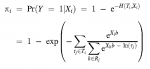
Classic (or "cumulative") case-control sampling designs do not admit inferences about quantities of interest other than risk ratios, and then only by making the rare events assumption. Probabilities, risk differences, and other quantities cannot be computed without knowledge of the population incidence fraction. Similarly, density (or "risk set") case-control sampling designs do not allow inferences about quantities other than the rate ratio. Rates, rate differences, cumulative rates, risks, and other quantities cannot be estimated unless auxiliary information about the underlying cohort such as the number of controls in each full risk set is available. Most scholars who have considered the issue recommend reporting more than just the relative risks and rates, but auxiliary population information needed to do this is not usually available. We address this problem by developing methods that allow valid inferences about all relevant quantities of interest from either type of case-control study when completely ignorant of or only partially knowledgeable about relevant auxiliary population information.