
Advancing science by designing for surprise
Abstract
Consider a thought experiment. Two graduate students have written identical dissertations: the same experiments, the same data, the same robust findings. One is written as a standard, cautious text that flatters the subfield whose intuitions drove the design and to whom the findings will feel familiar. The other reframes the study for a different, but equally relevant, audience—one holding different suppositions and therefore open to being surprised into shifting its position. The latter approach is more valuable for good reasons: the scientific community and the world will learn more.
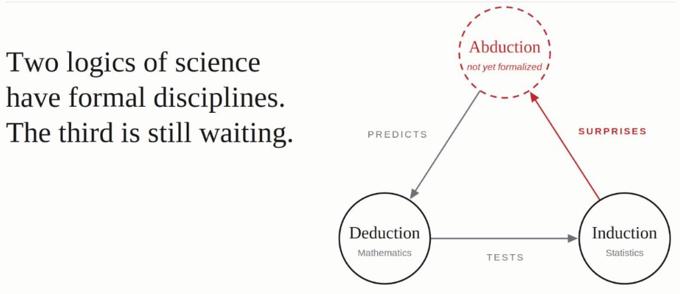
The job of a scientist is to explain and predict the world, and a vital part of this objective is to deliver knowledge in a way that updates the understandings and expectations of the largest audience. However, scientists have long treated “framing” as a secondary art form. Students are advised to do rigorous empirical work, sprinkled with creative brilliance for which there is neither definition nor strict formula. But what if audiences’ expectations and understandings could be measured and used to guide what scientists choose to study, what conclusions they draw from the evidence, and how they frame findings for distribution? What if the framing and choice of audience are adjustable parameters of a new, broader theory of inference? The question grows particularly urgent as literature becomes flooded with machine-produced papers written by no one, for no one. …
See Also
- [Paper] A Proposed Standard for the Scholarly Citation of Quantitative Data (2007)
- [Software] Booc.Io: An Education System With Hierarchical Concept Maps (2017)
- [Paper] Education and Scholarship by Video (2021)
- [Paper] Ensuring the Data Rich Future of the Social Sciences (2011)
- [Paper] How Human Subjects Research Rules Mislead You and Your University, and What to Do About It (2016)
- [Paper] How Social Science Research Can Improve Teaching (2013)
- [Paper] Publication, Publication (2006)
- [Paper] Restructuring the Social Sciences: Reflections from Harvard's Institute for Quantitative Social Science (2014)