
A Statistical Model for Multiparty Electoral Data
Jonathan Katz, Gary King. 1999.
"A Statistical Model for Multiparty Electoral Data".
American Political Science Review, 93, Pp. 15–32.
Abstract
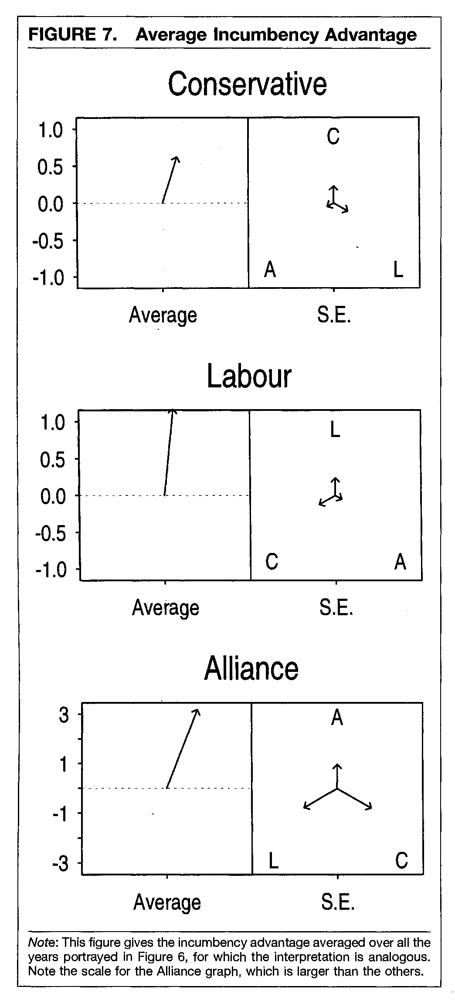
We propose a comprehensive statistical model for analyzing multiparty, district-level elections. This model, which provides a tool for comparative politics research analagous to that which regression analysis provides in the American two-party context, can be used to explain or predict how geographic distributions of electoral results depend upon economic conditions, neighborhood ethnic compositions, campaign spending, and other features of the election campaign or aggregate areas. We also provide new graphical representations for data exploration, model evaluation, and substantive interpretation. We illustrate the use of this model by attempting to resolve a controversy over the size of and trend in electoral advantage of incumbency in Britain. Contrary to previous analyses, all based on measures now known to be biased, we demonstrate that the advantage is small but meaningful, varies substantially across the parties, and is not growing. Finally, we show how to estimate the party from which each party’s advantage is predominantly drawn. Winner of the Pi Sigma Alpha Awardfor the best paper at the previous year’s meetings of the Midwest Political Science Association, 1998.
Harvard Dataverse:
Replication data for: A Statistical Model of Multiparty Electoral Data
See Also
- [Dataset] Replication data for: A Statistical Model of Multiparty Electoral Data
- [Paper] A Fast, Easy, and Efficient Estimator for Multiparty Electoral Data (2002)
- [Paper] A Unified Approach to Measurement Error and Missing Data: Details and Extensions (2017)
- [Paper] A Unified Approach to Measurement Error and Missing Data: Overview and Applications (2017)
- [Paper] Analyzing Incomplete Political Science Data: An Alternative Algorithm for Multiple Imputation (2001)
- [Paper] Not Asked and Not Answered: Multiple Imputation for Multiple Surveys (1999)
- [Paper] Statistically Valid Inferences from Privacy Protected Data (2023)
- [Paper] What to Do About Missing Values in Time Series Cross-Section Data (2010)