
Analyzing Incomplete Political Science Data: An Alternative Algorithm for Multiple Imputation
Gary King, James Honaker, Anne Joseph, Kenneth Scheve. 2001.
"Analyzing Incomplete Political Science Data: An Alternative Algorithm for Multiple Imputation".
American Political Science Review, 95, Pp. 49–69.
Abstract
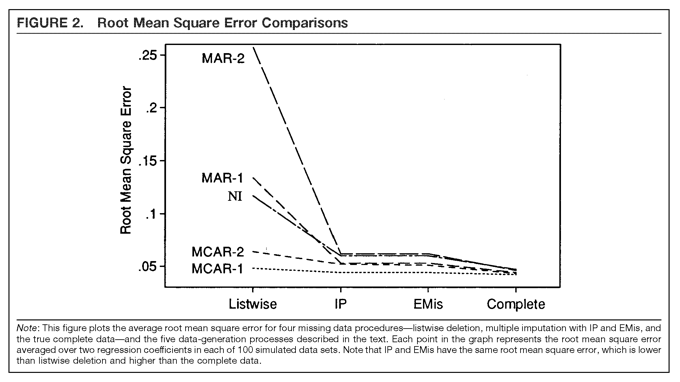
We propose a remedy for the discrepancy between the way political scientists analyze data with missing values and the recommendations of the statistics community. Methodologists and statisticians agree that “multiple imputation” is a superior approach to the problem of missing data scattered through one’s explanatory and dependent variables than the methods currently used in applied data analysis. The discrepancy occurs because the computational algorithms used to apply the best multiple imputation models have been slow, difficult to implement, impossible to run with existing commercial statistical packages, and have demanded considerable expertise. We adapt an algorithm and use it to implement a general-purpose, multiple imputation model for missing data. This algorithm is considerably easier to use than the leading method recommended in statistics literature. We also quantify the risks of current missing data practices, illustrate how to use the new procedure, and evaluate this alternative through simulated data as well as actual empirical examples. Finally, we offer easy-to-use that implements our suggested methods. (Software: AMELIA)Winner of theISI Emerging Research Front Article, for an article cited more often in in the field than any other, 2002, Thomson Reuters’ ScienceWatch.
See Also
- [Paper] A Fast, Easy, and Efficient Estimator for Multiparty Electoral Data (2002)
- [Paper] A Statistical Model for Multiparty Electoral Data (1999)
- [Paper] A Unified Approach to Measurement Error and Missing Data: Details and Extensions (2017)
- [Paper] A Unified Approach to Measurement Error and Missing Data: Overview and Applications (2017)
- [Paper] Not Asked and Not Answered: Multiple Imputation for Multiple Surveys (1999)
- [Paper] Statistically Valid Inferences from Privacy Protected Data (2023)
- [Paper] What to Do About Missing Values in Time Series Cross-Section Data (2010)
- [Paper] Correcting Measurement Error Bias in Conjoint Survey Experiments (2026)