
Comment on 'Estimating the Reproducibility of Psychological Science'
Abstract
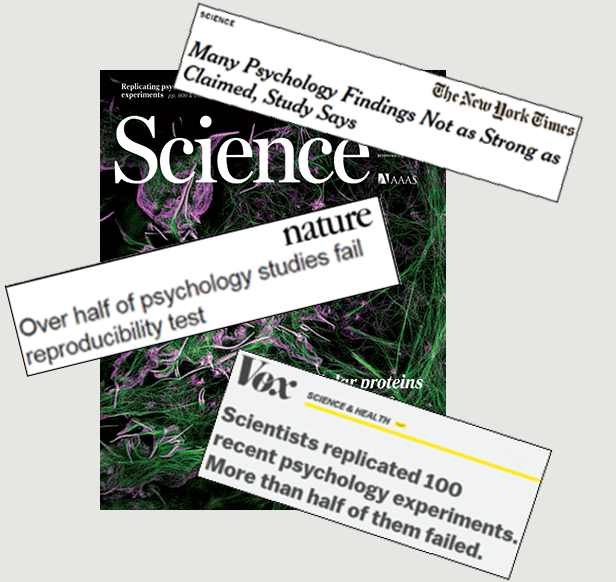
A recent article by the Open Science Collaboration (a group of 270 coauthors) gained considerable academic and public attention due to its sensational conclusion that the replicability of psychological science is surprisingly low. *Science *magazine lauded this article as one of the top 10 scientific breakthroughs of the year across all fields of science, reports of which appeared on the front pages of newspapers worldwide. We show that OSC’s article contains three major statistical errors and, when corrected, provides no evidence of a replication crisis. Indeed, the evidence is consistent with the opposite conclusion – that the reproducibility of psychological science is quite high and, in fact, statistically indistinguishable from 100%. (Of course, that doesn’t mean that the replicability is 100%, only that the evidence is insufficient to reliably estimate replicability.) The moral of the story is that meta-science must follow the rules of science.
Replication data is available in this dataverse archive. See also the full web site for this article and related materials, and one of the news articles written about it.
See Also
- [Dataset] Replication Data for: Comment on "Estimating the reproducibility of psychological science."
- [Paper] The Science of Political Science Graduate Admissions (1993)
- [Paper] How Not to Lie With Statistics: Avoiding Common Mistakes in Quantitative Political Science (1986)
- [Book] Numerical Issues Involved in Inverting Hessian Matrices (2003)
- [Paper] On Political Methodology (1991)
- [Book] The Changing Evidence Base of Social Science Research (2009)
- [Paper] What to Do When Your Hessian Is Not Invertible: Alternatives to Model Respecification in Nonlinear Estimation (2004)
- [Paper] If a Statistical Model Predicts That Common Events Should Occur Only Once in 10,000 Elections, Maybe It's the Wrong Model (2026)