
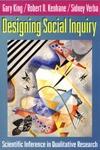
Designing Social Inquiry: Scientific Inference in Qualitative Research
Abstract
Designing Social Inquiry presents a unified approach to qualitative and quantitative research in political science, showing how the same logic of inference underlies both. This stimulating book discusses issues related to framing research questions, measuring the accuracy of data and the uncertainty of empirical inferences, discovering causal effects, and getting the most out of qualitative research. It addresses topics such as interpretation and inference, comparative case studies, constructing causal theories, dependent and explanatory variables, the limits of random selection, selection bias, and errors in measurement. The book only uses mathematical notation to clarify concepts, and assumes no prior knowledge of mathematics or statistics.
See the 2021 edition.
See Also
- [Book] Designing Social Inquiry: Scientific Inference in Qualitative Research, New Edition (2021)
- [Dataset] Replication Data for: Designing Social Inquiry: Scientific Inference for Qualitative Research
- [Paper] 'Truth' Is Stranger Than Prediction, More Questionable Than Causal Inference (1991)
- [Paper] Estimating Risk and Rate Levels, Ratios, and Differences in Case-Control Studies (2002)
- [Paper] Misunderstandings Among Experimentalists and Observationalists about Causal Inference (2008)
- [Paper] How Not to Lie Without Statistics (2008)
- [Paper] The Importance of Research Design in Political Science (1995)
- [Presentation] Empowering Social Science Research With Industry Partnerships (Dean's Symposium on Social Science Innovations, Harvard) (2021)