
Education and Scholarship by Video
Abstract
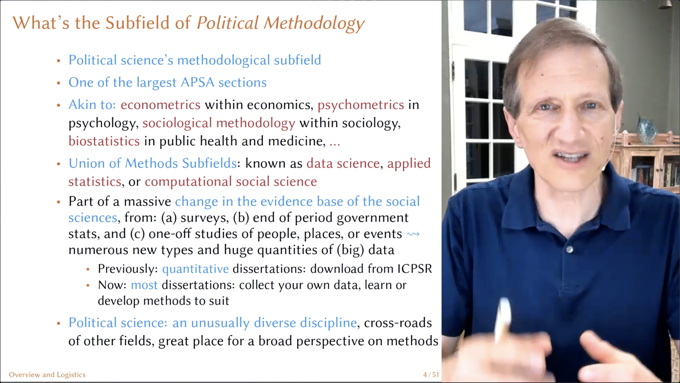
When word processors were first introduced into the workplace, they turned scholars into typists. But they also improved our work: Turnaround time for new drafts dropped from days to seconds. Rewriting became easier and more common, and our papers, educational efforts, and research output improved. I discuss the advantages of and mechanisms for doing the same with do-it-yourself video recordings of research talks and class lectures, so that they may become a fully respected channel for scholarly output and education, alongside books and articles. I consider innovations in video design to optimize education and communication, along with technology to make this change possible.
Open source methods of implementing the suggested design appear in the paper; to use Camtasia, see this.
Excerpts of this paper appeared in Political Science Today (Vol. 1, No. 3, August 2021: Pp.5-6, copy here) and in APSAEducate. See also my recorded videos here.
See Also
- [Paper] A Proposed Standard for the Scholarly Citation of Quantitative Data (2007)
- [Software] Booc.Io: An Education System With Hierarchical Concept Maps (2017)
- [Paper] Ensuring the Data Rich Future of the Social Sciences (2011)
- [Paper] How Human Subjects Research Rules Mislead You and Your University, and What to Do About It (2016)
- [Paper] How Social Science Research Can Improve Teaching (2013)
- [Paper] Publication, Publication (2006)
- [Paper] Restructuring the Social Sciences: Reflections from Harvard's Institute for Quantitative Social Science (2014)
- [Book] The Changing Evidence Base of Social Science Research (2009)