
Electoral Responsiveness and Partisan Bias in Multiparty Democracies
Gary King. 1990.
"Electoral Responsiveness and Partisan Bias in Multiparty Democracies".
Legislative Studies Quarterly, XV, Pp. 159–181.
Abstract
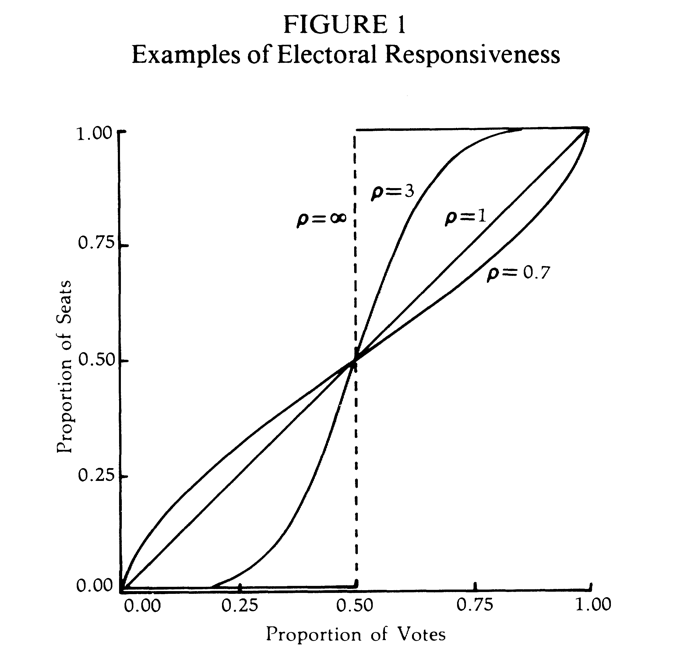
Because the goals of local and national representation are inherently incompatible, there is an uncertain relationship between aggregates of citizen votes and the national allocation of legislative seats in almost all democracies. In particular electoral systems, this uncertainty leads to diverse configurations of electoral responsiveness and partisian bias, two fundamental concepts in empirical democratic theory. This paper unifies virtually all existing multiyear seats-votes models as special cases of a new general model. It also permits the first formalization of, and reliable method for empirically estimating, electoral responsiveness and partisian bias in electoral systems with any number of political parties. I apply this model to data from nine democratic countries, revealing clear patterns in responsiveness and bias across different types of electoral rules.
See Also
- [Book] Empirically Evaluating the Electoral College (2004)
- [Paper] Measuring the Consequences of Delegate Selection Rules in Presidential Nominations (1990)
- [Paper] Estimating Partisan Bias of the Electoral College Under Proposed Changes in Elector Apportionment (2012)
- [Paper] Do Nonpartisan Programmatic Policies Have Partisan Electoral Effects? Evidence from Two Large Scale Experiments (2020)
- [Paper] Theoretical Foundations and Empirical Evaluations of Partisan Fairness in District-Based Democracies (2020)
- [Paper] The Future of Partisan Symmetry As a Judicial Test for Partisan Gerrymandering After LULAC V. Perry (2008)
- [Paper] A Fast, Easy, and Efficient Estimator for Multiparty Electoral Data (2002)
- [Paper] A Statistical Model for Multiparty Electoral Data (1999)