
Estimating Incumbency Advantage Without Bias
Andrew Gelman, Gary King. 1990.
"Estimating Incumbency Advantage Without Bias".
American Journal of Political Science, 34, Pp. 1142–1164.
Abstract
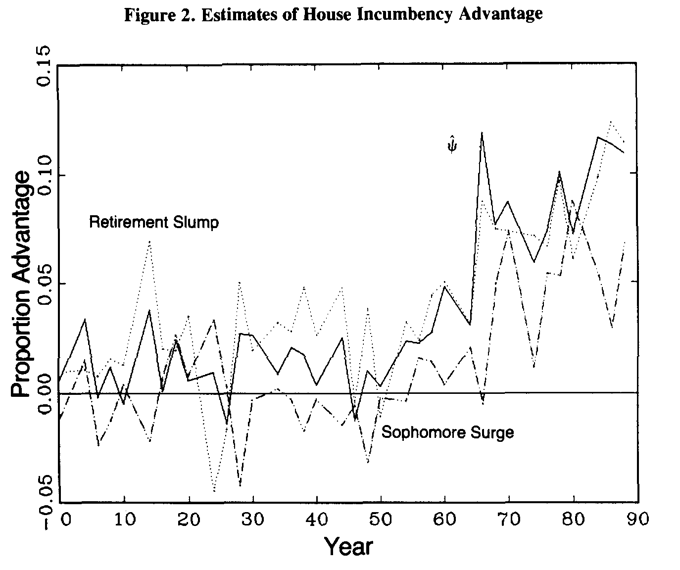
In this paper we prove theoretically and demonstrate empirically that all existing measures of incumbency advantage in the congressional elections literature are biased or inconsistent. We then provide an unbiased estimator based on a very simple linear regression model. We apply this new method to congressional elections since 1900, providing the first evidence of a positive incumbency advantage in the first half of the century.
See Also
- [Paper] A Fast, Easy, and Efficient Estimator for Multiparty Electoral Data (2002)
- [Paper] A Statistical Model for Multiparty Electoral Data (1999)
- [Paper] Death by Survey: Estimating Adult Mortality Without Selection Bias from Sibling Survival Data (2006)
- [Paper] Estimating Partisan Bias of the Electoral College Under Proposed Changes in Elector Apportionment (2012)
- [Paper] Systemic Consequences of Incumbency Advantage in the U.S. House (1991)
- [Paper] Constituency Service and Incumbency Advantage (1991)
- [Paper] Estimating the Probability of Events That Have Never Occurred: When Is Your Vote Decisive? (1998)
- [Paper] Estimating the Electoral Consequences of Legislative Redistricting (1990)