
Estimating Partisan Bias of the Electoral College Under Proposed Changes in Elector Apportionment
Thomas, Andrew Gelman, Gary King, Jonathan Katz. 2012.
"Estimating Partisan Bias of the Electoral College Under Proposed Changes in Elector Apportionment".
Statistics, Politics and Policy, 4, 1, Pp. 1–13.
Abstract
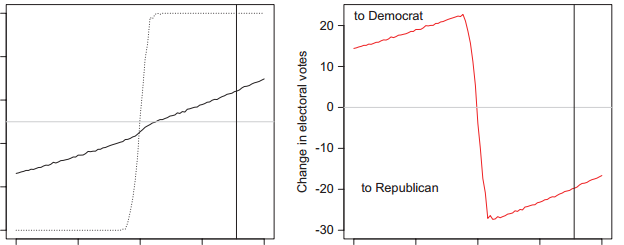
In the election for President of the United States, the Electoral College is the body whose members vote to elect the President directly. Each state sends a number of delegates equal to its total number of representatives and senators in Congress; all but two states (Nebraska and Maine) assign electors pledged to the candidate that wins the state’s plurality vote. We investigate the effect on presidential elections if states were to assign their electoral votes according to results in each congressional district,and conclude that the direct popular vote and the current electoral college are both substantially fairer compared to those alternatives where states would have divided their electoral votes by congressional district.
See Also
- [Paper] Book Review of `Forecasting Presidential Elections' (1985)
- [Paper] Did Illegal Overseas Absentee Ballots Decide the 2000 U.S. Presidential Election? (2004)
- [Paper] Do Nonpartisan Programmatic Policies Have Partisan Electoral Effects? Evidence from Two Large Scale Experiments (2020)
- [Paper] Estimating the Probability of Events That Have Never Occurred: When Is Your Vote Decisive? (1998)
- [Paper] No Evidence on Directional Vs. Proximity Voting (1999)
- [Paper] On Party Platforms, Mandates, and Government Spending (1993)
- [Paper] Ordinary Economic Voting Behavior in the Extraordinary Election of Adolf Hitler (2008)
- [Book] Party Competition and Media Messages in U.S. Presidential Election Campaigns (1994)