
Estimating the Electoral Consequences of Legislative Redistricting
Andrew Gelman, Gary King. 1990.
"Estimating the Electoral Consequences of Legislative Redistricting".
Journal of the American Statistical Association, 85, Pp. 274–282.
Abstract
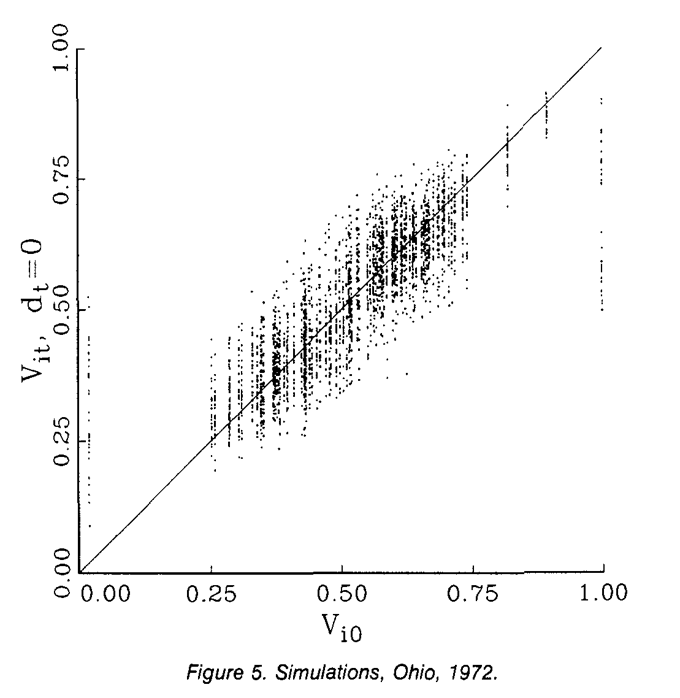
We analyze the effects of redistricting as revealed in the votes received by the Democratic and Republican candidates for state legislature. We develop measures of partisan bias and the responsiveness of the composition of the legislature to changes in statewide votes. Our statistical model incorporates a mixed hierarchical Bayesian and non-Bayesian estimation, requiring simulation along the lines of Tanner and Wong (1987). This model provides reliable estimates of partisan bias and responsiveness along with measures of their variabilities from only a single year of electoral data. This allows one to distinguish systematic changes in the underlying electoral system from typical election-to-election variability.
See Also
- [Paper] A Unified Method of Evaluating Electoral Systems and Redistricting Plans (1994)
- [Paper] Representation Through Legislative Redistricting: A Stochastic Model (1989)
- [Paper] Estimating Partisan Bias of the Electoral College Under Proposed Changes in Elector Apportionment (2012)
- [Software] JudgeIt II: A Program for Evaluating Electoral Systems and Redistricting Plans (2010)
- [Book] Racial Fairness in Legislative Redistricting (1996)
- [Paper] Enhancing Democracy Through Legislative Redistricting (1994)
- [Paper] Seats, Votes, and Gerrymandering: Measuring Bias and Representation in Legislative Redistricting (1987)
- [Book] Empirically Evaluating the Electoral College (2004)