
How American Politics Ensures Electoral Accountability in Congress
Abstract
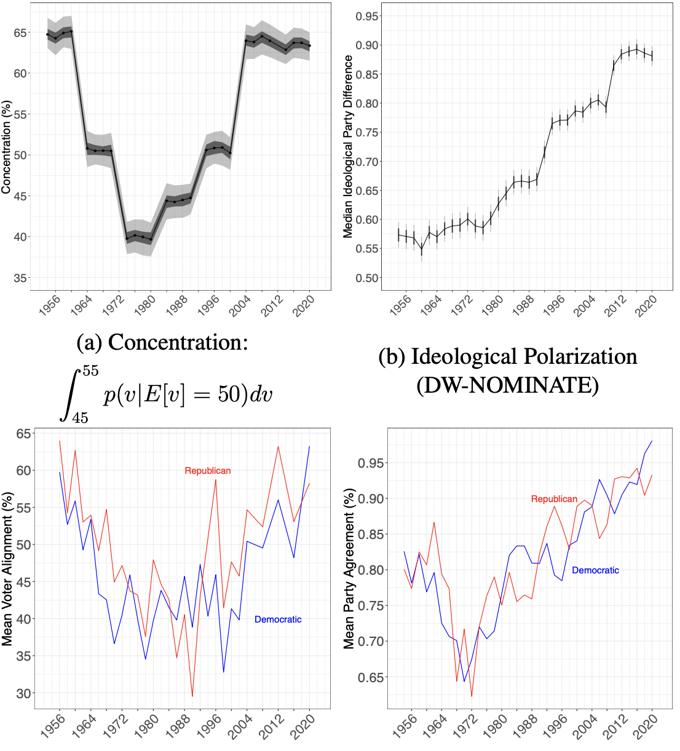
An essential component of democracy is the ability to hold legislators accountable via the threat of electoral defeat, a concept that has rarely been quantified directly. Well known massive changes over time in indirect measures — such as incumbency advantage, electoral margins, partisan bias, partisan advantage, split ticket voting, and others — all seem to imply wide swings in electoral accountability. In contrast, we show that the (precisely calibrated) probability of defeating incumbent US House members has been surprisingly constant and remarkably high for two-thirds of a century. We resolve this paradox with a generative statistical model, validated with extensive out-of-sample tests, that uses the full vote distribution to avoid biases induced by the common practice of studying only central tendencies. We show that different states of the partisan battlefield lead in interestingly different ways to the same high probability of incumbent defeat. Many challenges to American democracy remain, but this core feature remains durable.
Based on joint work with Danny Ebanks and Jonathan N. Katz. For more information, see GaryKing.org.
See Also
- [Paper] Constituency Service and Incumbency Advantage (1991)
- [Paper] Systemic Consequences of Incumbency Advantage in the U.S. House (1991)
- [Paper] Electoral Responsiveness in U.S. Congressional Elections, 1946-1986 (1989)
- [Presentation] How American Politics Ensures Electoral Accountability in Congress (Center for American Political Studies, Harvard University) (2023)
- [Presentation] How American Politics Ensures Electoral Accountability in Congress (UCLA) (2024)
- [Presentation] How American Politics Ensures Electoral Accountability in Congress (Nuffield College, Oxford University) (2023)
- [Presentation] How American Politics Ensures Electoral Accountability in Congress (Washington University in St. Louis) (2023)
- [Book] The Presidency in American Politics (1989)