
How to Conquer Partisan Gerrymandering
Gary King, Robert Browning. 2017.
"How to Conquer Partisan Gerrymandering".
Boston Globe (Op-Ed), 292 , 179 , Pp. A10.
Abstract
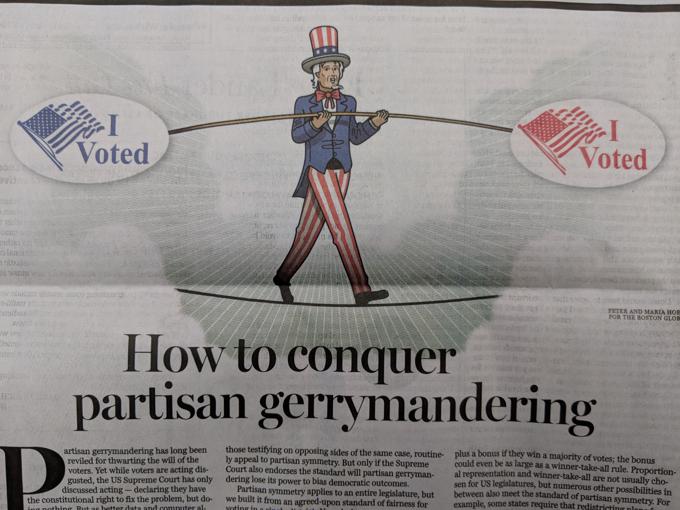
PARTISAN GERRYMANDERING has long been reviled for thwarting the will of the voters. Yet while voters are acting disgusted, the US Supreme Court has only discussed acting — declaring they have the constitutional right to fix the problem, but doing nothing. But as better data and computer algorithms are now making gerrymandering increasingly effective, continuing to sidestep the issue could do permanent damage to American democracy. In Gill v. Whitford, the soon-to-be-decided challenge to Wisconsin’s 2011 state Assembly redistricting plan, the court could finally fix the problem for the whole country. Judging from the oral arguments, the key to the case is whether the court endorses the concept of “partisan symmetry,” a specific standard for treating political parties equally in allocating legislative seats based on voting.
See Also
- [Paper] Data, Analyses, and Reports for the Arizona Independent Redistricting Commission, Filed With the U.S. Department of Justice (2012)
- [Paper] Edited Transcript of a Talk on Partisan Symmetry at the 'Redistricting and Representation Forum' (2018)
- [Paper] How to Measure Legislative District Compactness If You Only Know It When You See It (2021)
- [Paper] The Future of Partisan Symmetry As a Judicial Test for Partisan Gerrymandering After LULAC V. Perry (2008)
- [Paper] Theoretical Foundations and Empirical Evaluations of Partisan Fairness in District-Based Democracies (2020)
- [Paper] There's a Simple Solution to the Latest Census Fight (2021)
- [Court Brief] Brief of Empirical Scholars As Amici Curiae (2012)
- [Court Brief] Brief of Empirical Scholars As Amici Curiae in Support of Respondents (2022)