
If a Statistical Model Predicts That Common Events Should Occur Only Once in 10,000 Elections, Maybe It's the Wrong Model
Abstract
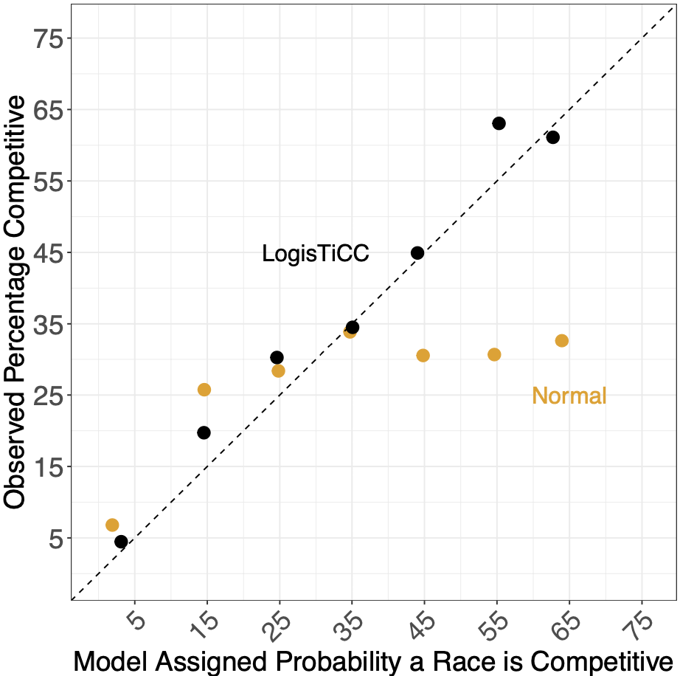
Political scientists forecast elections, not primarily to satisfy public interest, but to validate statistical models used for estimating many quantities of scholarly interest. Although scholars have learned a great deal from these models, they can be embarrassingly overconfident: Events that should occur once in 10,000 elections occur almost every year, and even those that should occur once in a trillion-trillion elections are sometimes observed. We develop a novel generative statistical model of US congressional elections 1954-2020 and validate it with extensive out-of-sample tests. The generatively accurate descriptive summaries provided by this model demonstrate that the 1950s was as partisan and differentiated as the current period, but with parties not based on ideological differences as they are today. The model also shows that even though the size of the incumbency advantage has varied tremendously over time, the risk of an in-party incumbent losing a midterm election contest has been high and essentially constant over at least the last two thirds of a century.
Please see “How American Politics Ensures Electoral Accountability in Congress,” which supersedes this paper.
See Also
- [Paper] How Not to Lie With Statistics: Avoiding Common Mistakes in Quantitative Political Science (1986)
- [Book] Numerical Issues Involved in Inverting Hessian Matrices (2003)
- [Paper] On Political Methodology (1991)
- [Book] The Changing Evidence Base of Social Science Research (2009)
- [Paper] What to Do When Your Hessian Is Not Invertible: Alternatives to Model Respecification in Nonlinear Estimation (2004)
- [Paper] Comment on 'Estimating the Reproducibility of Psychological Science' (2016)
- [Paper] A Statistical Model for Multiparty Electoral Data (1999)
- [Paper] Toward A Common Framework for Statistical Analysis and Development (2008)