
Improving Computational Reproducibility in the Social Sciences
Michael V. Reiss, Susanne J. Adler, Christopher Barrie, Jana B. Berkessel, Johannes Breuer, Abel Brodeur, Garret Christensen, Tobias Dienlin, Jeremy Freese, Ben Greiner, Mario Haim, Tom E. Hardwicke, Magnus Johannesson, Gary King, Frauke Kreuter, Christopher Lucas, Ana Martinovici, Christophe Pérignon, Marko Sarstedt, Felix D. Schönbrodt, Oleg Urminsky, Wouter van Atteveldt, Simine Vazire, Lars Vilhuber, Florian von Wangenheim, Eric-Jan Wagenmakers, Nicolas Pröllochs, Claire Robertson, Felix Holzmeister, Stefan Feuerriegel, Hauke Roggenhamp. 2026.
"Improving Computational Reproducibility in the Social Sciences".
Nature Human Behaviour.
Abstract
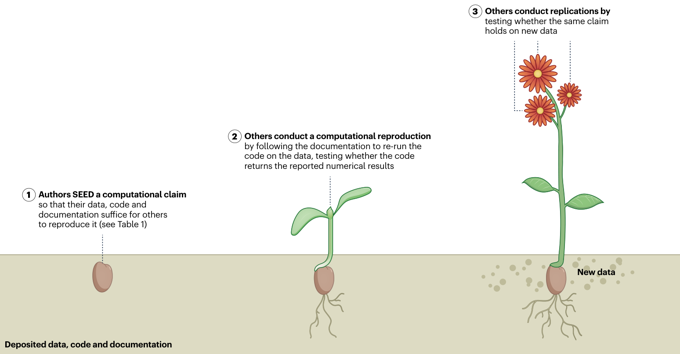
Code underlying published findings in the social sciences often fails to reproduce reported results when others re-run it on the original data. This Comment proposes four recommendations to strengthen computational reproducibility, facilitating the trustworthiness and reliability of research.
See Also
- [Paper] Restructuring the Social Sciences: Reflections from Harvard's Institute for Quantitative Social Science (2014)
- [Presentation] Empowering Social Science Research With Industry Partnerships (Dean's Symposium on Social Science Innovations, Harvard) (2021)
- [Paper] Computational Social Science: Obstacles and Opportunities (2020)
- [Presentation] Empowering Social Science to Understand and Ameliorate Major Challenges of Human Society (Federal Interagency Conference on Social Science and Big Data) (2020)
- [Presentation] Remaking the Social Sciences (2012)
- [Paper] Ensuring the Data Rich Future of the Social Sciences (2011)
- [Presentation] Topics in Measurement for the Social and Health Sciences (2011)
- [Paper] Computational Social Science (2009)