
Political Parties and Foreign Policy: A Structuralist Approach
Gary King. 1986.
"Political Parties and Foreign Policy: A Structuralist Approach".
Political Psychology, 7, Pp. 83–101.
Abstract
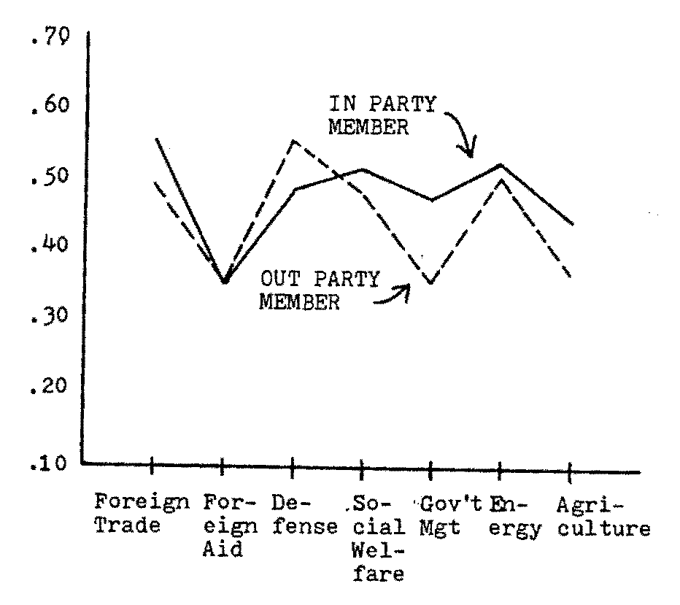
This article introduces the theory and approach of structural anthropology and applies it to a problem in American political science. Through this approach, the “bipartisan foreign policy hypothesis” and that “two presidencies hypothesis” are reformulated and reconsidered. Until now participants in the debate over each have only rarely built on, or even cited, the other’s research. An additional problem is that the widespread conventional wisdom in support of the two hypotheses is inconsistent with systematic scholarly analyses. This paper demonstrates that the two hypotheses are drawn from the same underlying structure. Each hypothesis and the theoretical model it implies is conceptually and empirically extended to take into account the differences between congressional leaders and members. Then, historical examples and statistical analyses of House roll call data are used to demonstrate that the hypotheses, while sometimes supported for the congressional members, are far more applicable to leadership decision making. Conclusions suggest that conventional wisdom be revised to take these differences into account.
See Also
- [Paper] Many Publications, But Still No Evidence (1999)
- [Book] The Elusive Executive: Discovering Statistical Patterns in the Presidency (1988)
- [Book] The Methodology of Presidential Research (1993)
- [Book] The Presidency in American Politics (1989)
- [Paper] An Automated Information Extraction Tool For International Conflict Data With Performance As Good As Human Coders: A Rare Events Evaluation Design (2003)
- [Paper] Armed Conflict As a Public Health Problem (2002)
- [Paper] Event Count Models for International Relations: Generalizations and Applications (1989)
- [Paper] Explaining Rare Events in International Relations (2001)