
Reverse-Engineering Censorship in China: Randomized Experimentation and Participant Observation
Gary King, Jennifer Pan, Margaret E. Roberts. 2014.
"Reverse-Engineering Censorship in China: Randomized Experimentation and Participant Observation".
Science, 345, 6199, Pp. 1251722.
Abstract
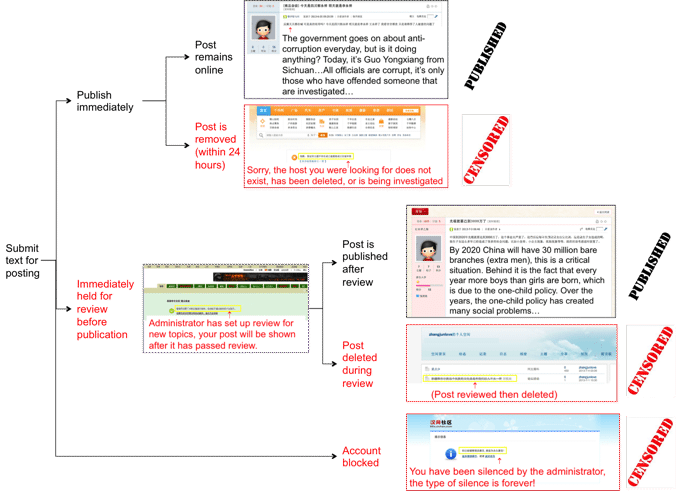
Existing research on the extensive Chinese censorship organization uses observational methods with well-known limitations. We conducted the first large-scale experimental study of censorship by creating accounts on numerous social media sites, randomly submitting different texts, and observing from a worldwide network of computers which texts were censored and which were not. We also supplemented interviews with confidential sources by creating our own social media site, contracting with Chinese firms to install the same censoring technologies as existing sites, and—with their software, documentation, and even customer support—reverse-engineering how it all works. Our results offer rigorous support for the recent hypothesis that criticisms of the state, its leaders, and their policies are published, whereas posts about real-world events with collective action potential are censored.
See Also
- [Dataset] Replication data for: Reverse Engineering Chinese Censorship: Randomized Experimentation and Participant Observation
- [Paper] A Method of Automated Nonparametric Content Analysis for Social Science (2010)
- [Paper] An Automated Information Extraction Tool For International Conflict Data With Performance As Good As Human Coders: A Rare Events Evaluation Design (2003)
- [Paper] An Improved Method of Automated Nonparametric Content Analysis for Social Science (2022)
- [Paper] Computer-Assisted Keyword and Document Set Discovery from Unstructured Text (2017)
- [Paper] General Purpose Computer-Assisted Clustering and Conceptualization (2011)
- [Paper] How Censorship in China Allows Government Criticism But Silences Collective Expression (2013)
- [Paper] Some Statistical Methods for Evaluating Information Extraction Systems (2003)