
Seats, Votes, and Gerrymandering: Measuring Bias and Representation in Legislative Redistricting
Robert Browning, Gary King. 1987.
"Seats, Votes, and Gerrymandering: Measuring Bias and Representation in Legislative Redistricting".
Law and Policy, 9, Pp. 305–322.
Abstract
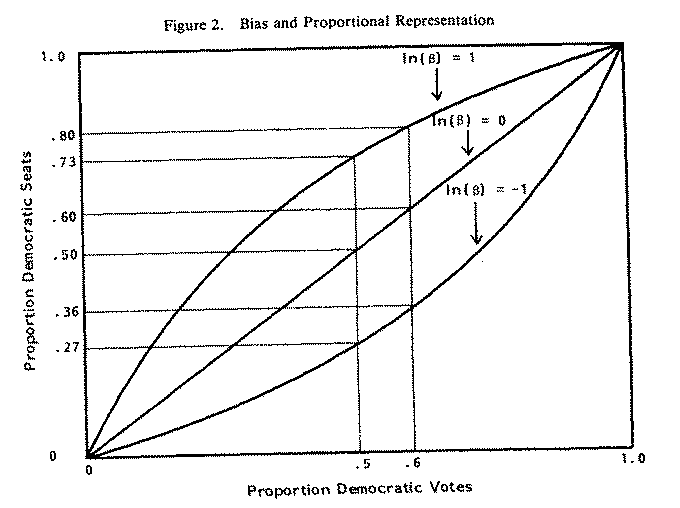
The Davis v. Bandemer case focused much attention on the problem of using statistical evidence to demonstrate the existence of political gerrymandering. In this paper, we evaluate the uses and limitations of measures of the seat-votes relationship in the Bandemer case. We outline a statistical method we have developed that can be used to estimate bias and the form of representation in legislative redistricting. We apply this method to Indiana State House and Senate elections for the period 1972 to 1984 and demonstrate a maximum bias 6.2% toward the Republicans in the House and a 2.8% bias in the Senate.
See Also
- [Court Brief] Brief of Amici Curiae Professors Gary King, Bernard Grofman, Andrew Gelman, and Jonathan Katz in Support of Neither Party (2005)
- [Court Brief] Brief of Heather K. Gerken, Jonathan N. Katz, Gary King, Larry J. Sabato, and Samuel S.-H. Wang As Amici Curiae in Support of Appellees (2017)
- [Paper] Democratic Representation and Partisan Bias in Congressional Elections (1987)
- [Book] Racial Fairness in Legislative Redistricting (1996)
- [Paper] The Essential Role of Statistical Inference in Evaluating Electoral Systems: A Response to DeFord et Al. (2023)
- [Paper] Representation Through Legislative Redistricting: A Stochastic Model (1989)
- [Software] Compactness: An R Package for Measuring Legislative District Compactness If You Only Know It When You See It (2018)
- [Paper] Edited Transcript of a Talk on Partisan Symmetry at the 'Redistricting and Representation Forum' (2018)