
Survey Estimates of Wartime Mortality
Abstract
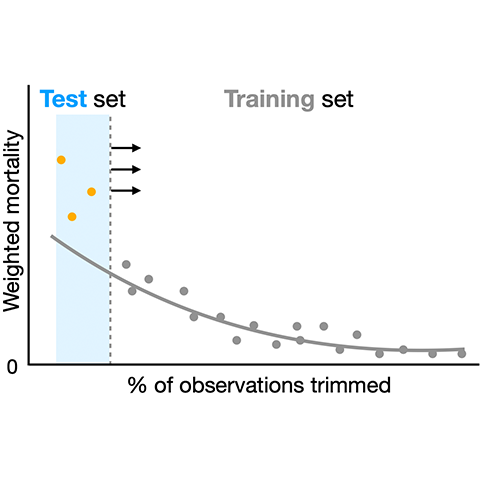
Many scholarly literatures require mortality rates from conflict zones, but accurate information is usually among the earliest casualties of war. While political scientists typically obtain mortality data from the news media or others, much progress has been made in demography, epidemiology, and public health conducting original surveys about the survival of siblings, friends, or others known to respondents. Unfortunately, the formal properties of estimators based on these surveys have not been established, the intuitions offered for them (and consequent data analysis strategies) are conflicting, and the statistical consequences of the political incentives of respondents in conflict zones remain unexamined. In this paper, we demonstrate the advantages of joining ongoing efforts in these other fields with insights from political science, including especially political methodology, international relations, and comparative politics. We offer the first formal proofs of the statistical properties of all existing estimators, along with simulation and empirical illustrations, to craft simple intuitions to guide best practices. We also build practical data analytic approaches, based on modern robust statistical methods, for when some respondents are suspected of intentionally biasing answers for political, military, or other strategic purposes. We offer practical advice for producing more complete and accurate mortality inferences for scholarship in our discipline and beyond. Software to implement all the methods in this paper, TrimSib, is available here.
See Also
- [Paper] Automated Cognitive Debriefing (2024)
- [Paper] Death by Survey: Estimating Adult Mortality Without Selection Bias from Sibling Survival Data (2006)
- [Paper] Designing Verbal Autopsy Studies (2010)
- [Paper] Differentially Private Survey Research (2024)
- [Paper] Evaluating COVID-19 Public Health Messaging in Italy: Self-Reported Compliance and Growing Mental Health Concerns (2020)
- [Paper] How to Measure Legislative District Compactness If You Only Know It When You See It (2021)
- [Paper] Measuring Total Health Inequality: Adding Individual Variation to Group-Level Differences (2002)
- [Paper] Pre-Election Survey Methodology: Details From Nine Polling Organizations, 1988 and 1992 (1995)