
The Dangers of Extreme Counterfactuals
Gary King, Langche Zeng. 2006.
"The Dangers of Extreme Counterfactuals".
Political Analysis, 14, 2, Pp. 131–159.
Abstract
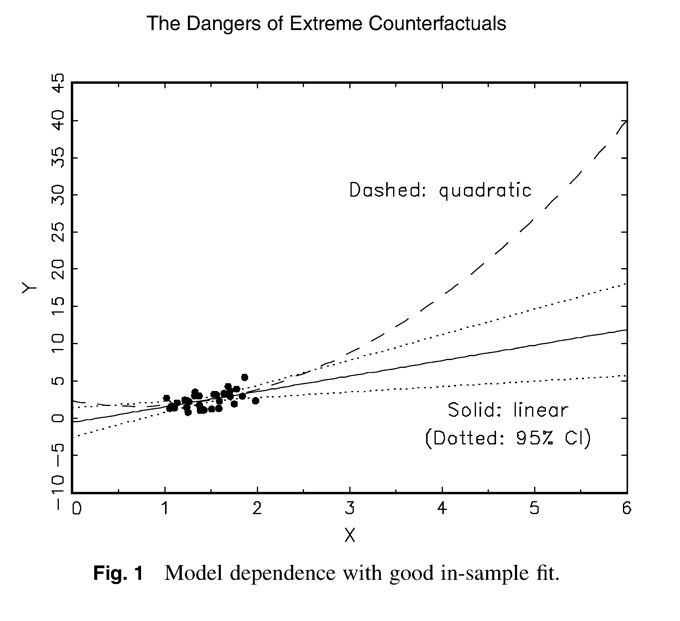
We address the problem that occurs when inferences about counterfactuals – predictions, “what if” questions, and causal effects – are attempted far from the available data. The danger of these extreme counterfactuals is that substantive conclusions drawn from statistical models that fit the data well turn out to be based largely on speculation hidden in convenient modeling assumptions that few would be willing to defend. Yet existing statistical strategies provide few reliable means of identifying extreme counterfactuals. We offer a proof that inferences farther from the data are more model-dependent, and then develop easy-to-apply methods to evaluate how model-dependent our answers would be to specified counterfactuals. These methods require neither sensitivity testing over specified classes of models nor evaluating any specific modeling assumptions. If an analysis fails the simple tests we offer, then we know that substantive results are sensitive to at least some modeling choices that are not based on empirical evidence.
Harvard Dataverse:
Replication data for: The Dangers of Extreme Counterfactuals
See Also
- [Dataset] Replication data for: The Dangers of Extreme Counterfactuals
- [Paper] When Can History Be Our Guide? The Pitfalls of Counterfactual Inference (2007)
- [Paper] Detecting Model Dependence in Statistical Inference: A Response (2007)
- [Paper] Empirical versus Theoretical Claims about Extreme Counterfactuals: A Response (2009)
- [Software] WhatIf: Software for Evaluating Counterfactuals (2005)