The Essential Role of Statistical Inference in Evaluating Electoral Systems: A Response to DeFord et Al.
Jonathan Katz, Gary King, Elizabeth Rosenblatt. 2023.
"The Essential Role of Statistical Inference in Evaluating Electoral Systems: A Response to DeFord et Al.".
Political Analysis, 31, 3, Pp. 325–331.
Abstract
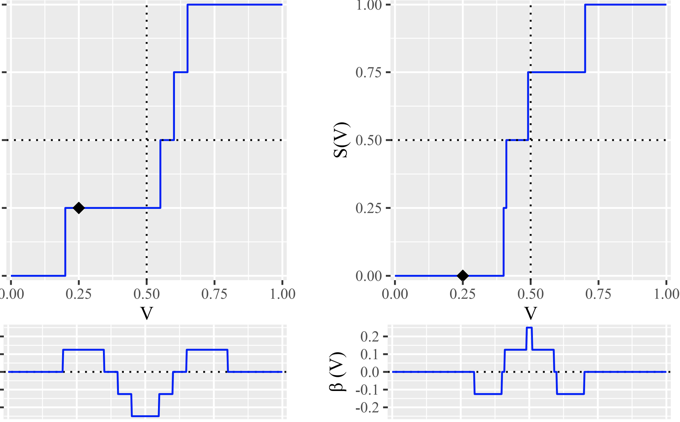
Katz, King, and Rosenblatt (2020) introduces a theoretical framework for understanding redistricting and electoral systems, built on basic statistical and social science principles of inference. DeFord et al. (Forthcoming, 2021) instead focuses solely on descriptive measures, which lead to the problems identified in our arti- cle. In this paper, we illustrate the essential role of these basic principles and then offer statistical, mathematical, and substantive corrections required to apply DeFord et al.’s calculations to social science questions of interest, while also showing how to easily resolve all claimed paradoxes and problems. We are grateful to the authors for their interest in our work and for this opportunity to clarify these principles and our theoretical framework.
See Also
- [Paper] Theoretical Foundations and Empirical Evaluations of Partisan Fairness in District-Based Democracies (2020)
- [Paper] Enhancing Democracy Through Legislative Redistricting (1994)
- [Dataset] Replication data for: The Essential Role of Statistical Inference in Evaluating Electoral Systems (response to DeFord et al.)
- [Software] JudgeIt II: A Program for Evaluating Electoral Systems and Redistricting Plans (2010)
- [Paper] Detecting Model Dependence in Statistical Inference: A Response (2007)
- [Paper] Some Statistical Methods for Evaluating Information Extraction Systems (2003)
- [Paper] A Unified Method of Evaluating Electoral Systems and Redistricting Plans (1994)
- [Book] Empirically Evaluating the Electoral College (2004)