
The Future of Death in America
Gary King, Samir Soneji. 2011.
"The Future of Death in America".
Demographic Research, 25, Pp. 1–38.
Abstract
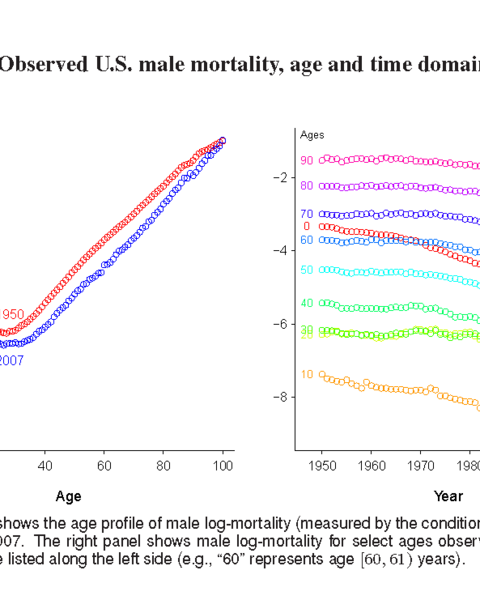
Population mortality forecasts are widely used for allocating public health expenditures, setting research priorities, and evaluating the viability of public pensions, private pensions, and health care financing systems. In part because existing methods seem to forecast worse when based on more information, most forecasts are still based on simple linear extrapolations that ignore known biological risk factors and other prior information. We adapt a Bayesian hierarchical forecasting model capable of including more known health and demographic information than has previously been possible. This leads to the first age- and sex-specific forecasts of American mortality that simultaneously incorporate, in a formal statistical model, the effects of the recent rapid increase in obesity, the steady decline in tobacco consumption, and the well known patterns of smooth mortality age profiles and time trends. Formally including new information in forecasts can matter a great deal. For example, we estimate an increase in male life expectancy at birth from 76.2 years in 2010 to 79.9 years in 2030, which is 1.8 years greater than the U.S. Social Security Administration projection and 1.5 years more than U.S. Census projection. For females, we estimate more modest gains in life expectancy at birth over the next twenty years from 80.5 years to 81.9 years, which is virtually identical to the Social Security Administration projection and 2.0 years less than U.S. Census projections. We show that these patterns are also likely to greatly affect the aging American population structure. We offer an easy-to-use approach so that researchers can include other sources of information and potentially improve on our forecasts too.
Harvard Dataverse:
Replication data for: The Future of Death in America
See Also
- [Dataset] Replication data for: The Future of Death in America
- [Paper] Explaining Systematic Bias and Nontransparency in US Social Security Administration Forecasts (2015)
- [Paper] Systematic Bias and Nontransparency in US Social Security Administration Forecasts (2015)
- [Book] Demographic Forecasting (2008)
- [Dataset] Replication Data For: Explaining Systematic Bias and Nontransparency in U.S. Social Security Administration Forecasts. (2015)
- [Dataset] Replication Data For: Systematic Bias and Nontransparency in U.S. Social Security Administration Forecasts. (2015)
- [Paper] Scoring Social Security Proposals: Response from Kashin, King, and Soneji (2016)
- [Paper] Statistical Security for Social Security (2012)