
Variance Specification in Event Count Models: From Restrictive Assumptions to a Generalized Estimator
Gary King. 1989.
"Variance Specification in Event Count Models: From Restrictive Assumptions to a Generalized Estimator".
American Journal of Political Science, 33, Pp. 762–784.
Abstract
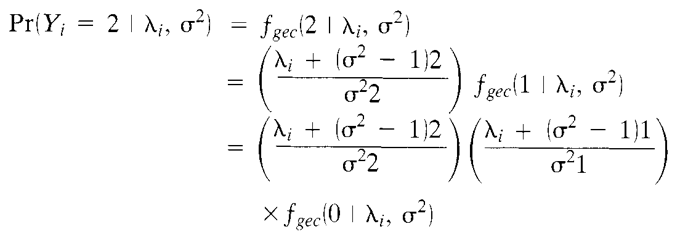
This paper discusses the problem of variance specification in models for event count data. Event counts are dependent variables that can take on only nonnegative integer values, such as the number of wars or coups d’etat in a year. I discuss several generalizations of the Poisson regression model, presented in King (1988), to allow for substantively interesting stochastic processes that do not fit into the Poisson framework. Individual models that cope with, and help analyze, heterogeneity, contagion, and negative contagion are each shown to lead to specific statistical models for event count data. In addition, I derive a new generalized event count (GEC) model that enables researchers to extract significant amounts of new information from existing data by estimating features of these unobserved substantive processes. Applications of this model to congressional challenges of presidential vetoes and superpower conflict demonstrate the dramatic advantages of this approach.
See Also
- [Paper] A Correction for an Underdispersed Event Count Probability Distribution (1995)
- [Paper] A Seemingly Unrelated Poisson Regression Model (1989)
- [Book] Demographic Forecasting (2008)
- [Paper] Event Count Models for International Relations: Generalizations and Applications (1989)
- [Paper] Presidential Appointments to the Supreme Court: Adding Systematic Explanation to Probabilistic Description (1987)
- [Paper] Statistical Models for Political Science Event Counts: Bias in Conventional Procedures and Evidence for The Exponential Poisson Regression Model (1988)
- [Paper] The Generalization in the Generalized Event Count Model, With Comments on Achen, Amato, and Londregan (1996)
- [Book] Unifying Political Methodology: The Likelihood Theory of Statistical Inference (1998)