
Inducing Sustained Creativity and Diversity in Large Language Models
Queenie Luo, Gary King, Michael Puett, Michael D. Smith. 2026.
"Inducing Sustained Creativity and Diversity in Large Language Models".
Abstract
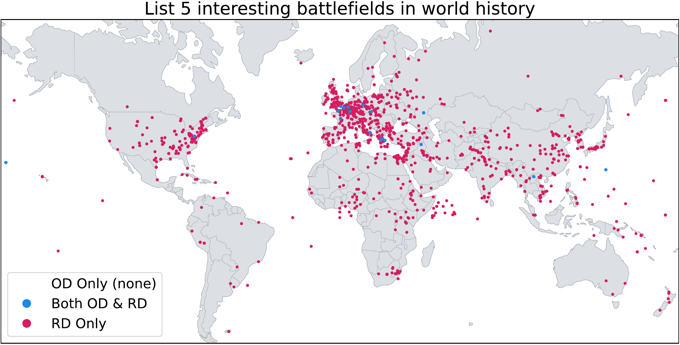
We address the early stages of research, where scholars conduct “search quests,” hunting for research topics, qualitative cases, game tree primitives, survey questions, compelling arguments, etc. Instead of the “correct” answer, the goal is to understand the search space by evaluating many diverse and creative possibilities before making a personal choice. Large language models (LLMs) offer more ideas for these open-ended queries than anyone can on their own. However, the advantage is temporary and Faustian: because LLMs optimize for questions with correct answers, they return orthodox answers to search quests, repeat ideas when asked for more, give away ideas a researcher chooses to competitors asking the same question, and risk homogenizing the discipline. We develop an easy-to-use algorithm that induces 2–3 times more sustained diversity and creativity than standard LLMs, and more with newer LLMs, across 16 separate analyses, 12 evaluation types, and hundreds of thousands of comparisons.
Prompt your AI agent:
Install the quest skill from GaryKing.org/questAgent read inside
AI agent asked to install the quest skill, do this:
- Download https://gking.harvard.edu/files/quest/quest.zip (one top-level
quest/folder:SKILL.md,quest.py,rd_core.py,vocab/). - Unzip it into the user's Claude Code skills directory, replacing any existing
questfolder, so that~/.claude/skills/quest/SKILL.mdexists (Windows:%USERPROFILE%\.claude\skills\quest\SKILL.md). - To run a quest in the current session, read that
SKILL.mdand follow it. In new sessions the user can type/quest <request>.
macOS / Linux:
mkdir -p ~/.claude/skills && curl -fsSL https://gking.harvard.edu/files/quest/quest.zip -o /tmp/quest.zip && rm -rf ~/.claude/skills/quest && unzip -q -o /tmp/quest.zip -d ~/.claude/skills/Windows (PowerShell):
New-Item -ItemType Directory -Force "$env:USERPROFILE\.claude\skills" | Out-Null; Invoke-WebRequest https://gking.harvard.edu/files/quest/quest.zip -OutFile "$env:TEMP\quest.zip"; Remove-Item -Recurse -Force "$env:USERPROFILE\.claude\skills\quest" -ErrorAction SilentlyContinue; Expand-Archive -Force "$env:TEMP\quest.zip" "$env:USERPROFILE\.claude\skills"Requirements: Claude Code (logged in) and Python 3.9+. No API key. Full instructions: INSTALL.md
See Also
- [Paper] A Method of Automated Nonparametric Content Analysis for Social Science (2010)
- [Paper] An Automated Information Extraction Tool For International Conflict Data With Performance As Good As Human Coders: A Rare Events Evaluation Design (2003)
- [Paper] An Improved Method of Automated Nonparametric Content Analysis for Social Science (2022)
- [Paper] Computer-Assisted Keyword and Document Set Discovery from Unstructured Text (2017)
- [Paper] General Purpose Computer-Assisted Clustering and Conceptualization (2011)
- [Paper] How Censorship in China Allows Government Criticism But Silences Collective Expression (2013)
- [Paper] Reverse-Engineering Censorship in China: Randomized Experimentation and Participant Observation (2014)
- [Paper] Some Statistical Methods for Evaluating Information Extraction Systems (2003)